
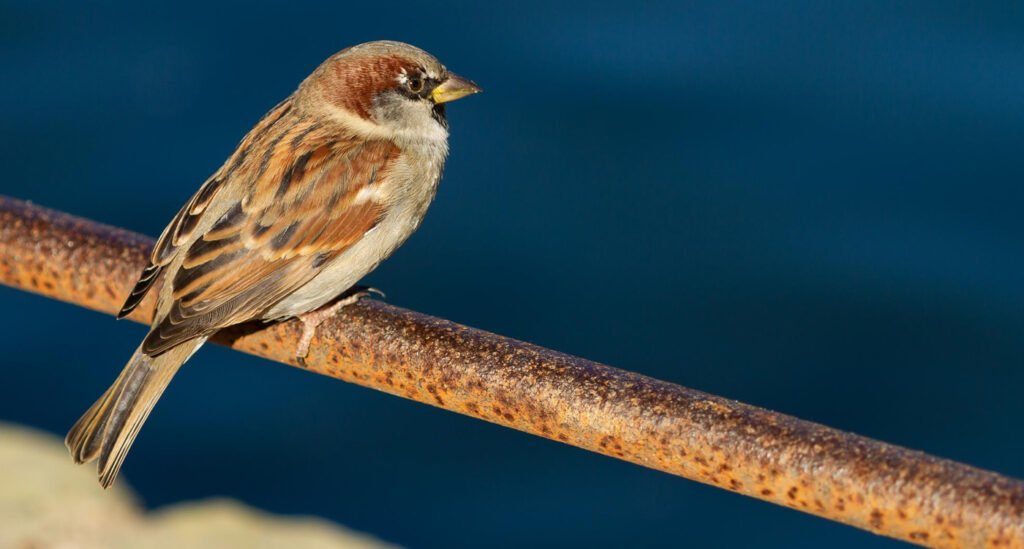
The ubiquitous House Sparrow, a small, adaptable bird found almost everywhere humans are.
It all started with birds coming into my balcony to eat food that I had spilled, as a kid. I was so excited to see them and started giving names to all the birds coming to my balcony. Birds started lining up when we provided a clean and constant food source. I was delighted as it also gave me an opportunity to see various birds at close quarters.Thereafter, we installed Bird Feeders & Nest boxes in our balcony, to provide the birds a place to nest & feed. Since then, a big flock of birds have made my balcony their home!
One bird which caught my attention was the Sparrow. They get their name, ‘House Sparrow’, because they have adapted to living around houses and buildings and have little fear of people. Sparrows are small, brown-coloured birds, with black streaks on their back. The male and female are easily distinguishable, due to their coloration. The male is dark brown, with a black bib, grey chest and white cheeks, whereas the female is light brown throughout its body, with no black bib, crown or white cheeks. As it is a social species, it is usually found in groups of eight to ten, chirping and chattering away.
The House Sparrow has evolved with humans, known to live in close contact with us, instead of in forests. For years, they have peacefully coexisted with us in our buildings and gardens, but in the last two decades, their population is on the decline in almost every city across the world. The reasons attributed are: rapidly changing cities are no longer a suitable habitat for the house sparrow, as the new and modern designs of infrastructure does not give any room for the sparrow to nest; pollution caused by microwave towers and pesticides; the house sparrow loses its foraging grounds (natural grasslands) as the green spaces in our cities give way to more concrete constructions.
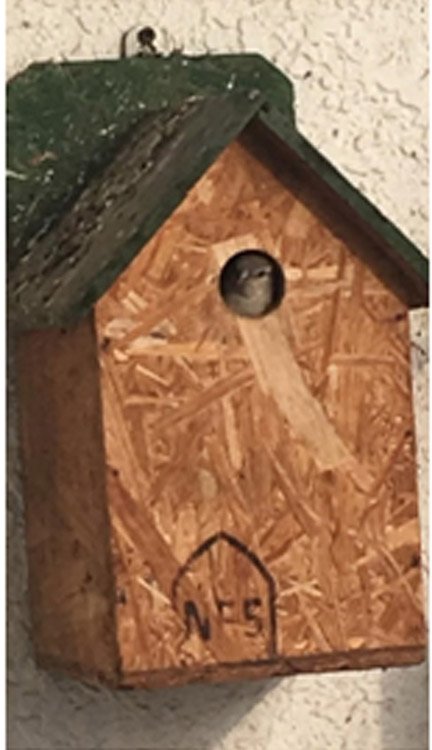
One of my nest boxes with a baby sparrow peeking out
Saving and conserving the House Sparrows became a cause very close to my heart, which led to me becoming a member of the Nature Forever Society (NFS). The Nature Forever Society has championed House Sparrow Conservation, along with common flora and fauna, for the past 17 years. They have been working towards saving sparrows by involving citizens from all walks of life- leading to a conservation movement in India where citizens created suitable habitats, resulting in hundreds and thousands of feeding and nesting opportunities for sparrows across the country.
World Sparrow Day is an initiative by the NFS, celebrated on 20th March worldwide, to raise awareness about the alarming decline in sparrow population and the threats they face like urbanisation, pollution and habitat loss. It is a global effort involving over 50 countries to create a platform for collaboration in protecting common birds. World Sparrow Day aims to bring issues to light about the decrease in the sparrow population and the need for their conservation. The day promotes action for safeguarding and conserving sparrows.The NFS also supports the United Nations Decade on Ecosystem Restoration 2021-2030.
Sparrows are vital for the ecosystem. These little birds support in further developing biodiversity and supporting plant growth in the ecosystem, resulting in healthier and greener environments. Sparrows consume and discharge seeds, helping in better spread of plant seeds, and making the climate around us flourish. They are one of nature’s most efficient insect controllers. One of the main reasons for decline of the house sparrows is also the lack of insect food which is caused by increasing use of pesticides and invasion of non-native plants in our ecosystem.
We can help sparrows by planting more native plants, saying no to pesticides and providing year round food to sparrows.Being a member of the Nature Forever Society, one gets a feeling of satisfaction and joy. We have installed Bird Feeders & Nestboxes and also encouraged people around us to adopt them. Over the years we have encouraged installation of over 500 birdfeeders and more than 150 nest boxes.
Sparrows are known for their adaptability and resilience. Despite their small size, they have thrived in diverse habitats, from urban landscapes to rural areas. We are loosing biodiversity and breaking the ecosystem faster than ever before.We should think “out of the cage” for all birds, and help in providing them food and a surrogate home for them to come back to.
It is said, that if you take care of birds, you take care of most of the environment problems in the world.